
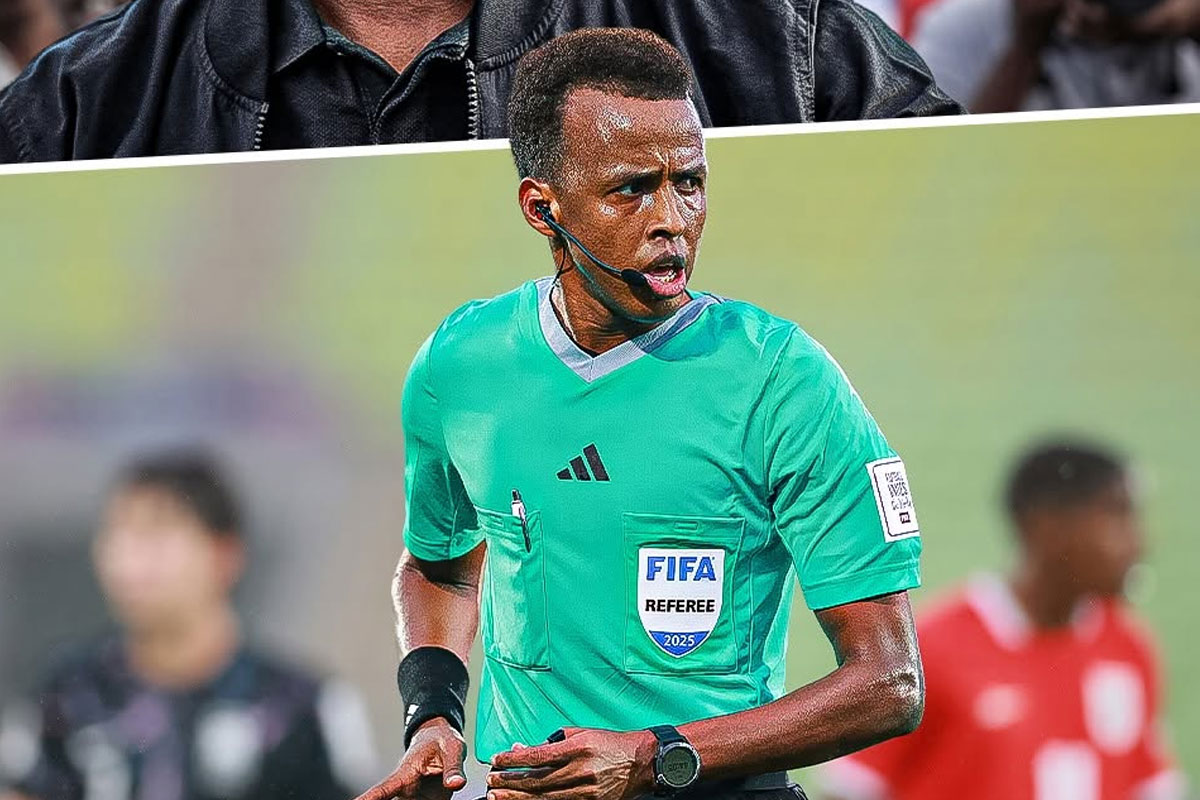
One of Africa’s most respected football referees, Somali official Omar Abdulkadir Artan, has been left devastated after being denied entry into the United States ahead of the FIFA Club World Cup, in a case that appears to be linked to mistaken identity and heightened security concerns.
Artan, 34, who was recently recognized among the continent’s elite match officials, was removed from FIFA’s officiating roster after U.S. immigration authorities refused him admission upon arrival at Miami International Airport.
The decision has triggered widespread debate across the football world, particularly in Africa, where many believe the Somali referee may have been wrongly caught up in security screening procedures because his name closely resembles that of an individual linked to the extremist group Al-Shabaab.

Similar Name Raises Security Concerns
According to reports published by The New York Times, U.S. authorities flagged Artan during immigration checks after discovering a similar name on sanctions databases maintained by the U.S. Office of Foreign Assets Control (OFAC).
The individual on the sanctions list is reportedly associated with Al-Shabaab, the Somalia-based militant group designated as a terrorist organization by the United States and several other countries.
However, there is no evidence connecting referee Omar Abdulkadir Artan to terrorism, criminal activity, or any extremist organization.
Immigration experts quoted by U.S. media indicated that the similarity between the names may have triggered additional scrutiny and lengthy questioning by border officials.
“I Came to Officiate Football”
Artan says he was subjected to an extensive interrogation that lasted several hours.
“They asked me several times if I had ever met representatives of Al-Shabaab. I explained to them that I knew nothing about this military group and that I was only in the United States to do my job as a referee,” he said.

The Somali official maintained that he had travelled to the United States solely to fulfill his FIFA assignment and had carried all the necessary travel documentation, including a valid visa and accreditation from football’s world governing body.
“I am very, very disappointed. I am simply a referee trying to live my dream, the biggest dream of my life, to come to the World Cup,” Artan told international media.
According to his account, he even presented FIFA documents, photographs from his refereeing career and other supporting materials to demonstrate his professional credentials.
Despite this, he says immigration officers detained him for approximately 11 hours before transferring him to a holding facility and eventually placing him on a return flight via Turkey back to Somalia.
FIFA Left Powerless
The controversy has also exposed the limits of FIFA’s influence when it comes to immigration matters. Initially, FIFA had indicated that Artan’s visa issues had been resolved and that he would be available for tournament duty. However, the governing body later confirmed that the referee would not participate after American authorities denied him entry.
In a statement, FIFA said it was not involved in host-country immigration processes and that decisions regarding admission ultimately rested with the government of the host nation. The organization further noted that authorities had informed them that Artan’s immigration status would not be changed.
A Celebrated Referee in Africa
Artan’s exclusion has been particularly painful for African football supporters given his reputation across the continent.
The Somali official has officiated numerous high-profile matches under the Confederation of African Football (CAF) and FIFA and was named CAF Referee of the Year in 2025.
Many football administrators, players and supporters regard him as one of Africa’s finest referees and believe he had earned his place at one of the world’s biggest football tournaments.
His return to Mogadishu was met with a hero’s welcome, with football officials, supporters and government representatives gathering at the airport to receive him.
Images circulating on social media showed Artan proudly displaying the Somali flag as hundreds rallied behind him following the setback.
Wider Questions Ahead of 2026 World Cup
The incident has also raised concerns about travel and visa procedures ahead of the 2026 FIFA World Cup, which will be jointly hosted by the United States, Canada and Mexico.
Several teams and officials have reportedly encountered immigration-related challenges in recent weeks.
Iraqi international striker Aymen Hussein was reportedly held for questioning for several hours upon arrival in the United States before eventually being allowed entry, while some members of Iran’s football delegation have also faced visa complications.
Observers say Artan’s case could become a significant talking point as global football prepares for the expanded World Cup tournament next year.
For many across Africa, the central question remains whether a respected referee lost a once-in-a-lifetime opportunity because his name happened to resemble that of someone else.
Until further clarification is provided by U.S. authorities, that question is likely to continue generating debate throughout the football community.

