
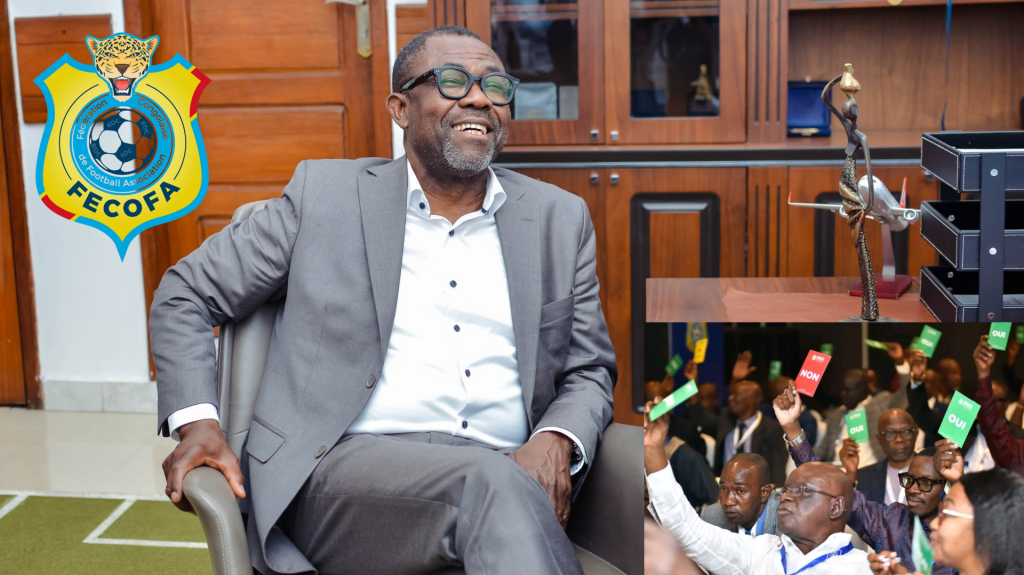
Véron Mosengo-Omba, the former general secretary of the Confederation of African Football, has been elected president of the Congolese Association Football Federation (FECOFA).
The federation said Wednesday that Mosengo-Omba, who was unopposed, received 60 votes from 65 to take over the position.
Only three delegates voted against his candidacy, while two ballots were declared invalid.
Initially, three lists were provisionally selected by the FECOFA Electoral Commission after the first processing of files. These were the lists of Véron Mosengo-Omba, Bosco Mwehu and Jean-Didier Massamba.
But later two candidates withdrew from the race for personal reasons, to leave Véron Mosengo-Omba as the sole provisional candidate.
At first other candidates whos had not been selected—namely Patrice Mangenda, Jean-Claude Mukanya, Jean-Max Mayaka, Kevin Issa and Aziz Makukula—had filed appeals, except for former DR Congo national team captain Shabani Nonda who had withdrawn.
Mosengo-Omba stepped down in March after five years as CAF general secretary. He is a university friend of FIFA president Gianni Infantino and followed him from UEFA to FIFA in 2016. Mosengo-Omba left FIFA to take over as CAF general secretary in 2021, replacing Constant Omari, the last elected president of the Congolese authority.
Mosengo-Omba unveiled the 11 major areas of his manifesto to revive the federation for the next four years. An ambitious project that should be carried out with a total amount of just over 25 million dollars for the development of football, both male and female, in all provinces of the DRC: from basic training to infrastructure, by going through the competitions as well as improving refereeing with the gradual introduction of VAR.
Among the 11 major areas of his project, include;
The refoundation of FECOFA and the restoration of trust;
The organization of regular and fair competitions;
The restructuring and professionalization of clubs;
The reconstruction of grassroots football in all provinces;
The structuring of the player’s and the player’s journey;
The massive training of coaches and educators;
The protection of refereeing and the development of football professions;
Strengthening of the National Technical Directorate;
Make women’s football a national priority;
Developing strong and stable national teams;
Finally, the modernization of infrastructure, ensuring financial autonomy and strengthening the image of Congolese football.

