
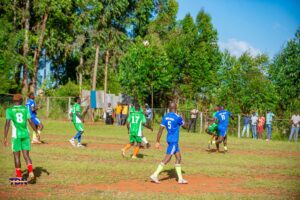
In the dust-caked fields of Kwanza, the sound of a referee’s whistle signifies more than just the start of a match—it marks the beginning of a rescue mission. The Kwanza Heroes League has evolved from a local pastime into a powerful engine for social and economic survival, proving that the “beautiful game” can mend the broken fabric of a community.
At the helm of this movement is Sam Goga, the League’s Secretary General and a member of the Dispute Resolution Committee. For Goga and his team, which also features Godricks Kitui (League Patron), Coen Masika (League coordinator), among others, the league’s identity is etched into its very name. In this corner of Trans Nzoia, a “Hero” isn’t a distant legend found in history books; it’s the young man standing on the pitch who chose a jersey over a vice. “The Heroes are the young people who were addicts and now have changed their lives through taking part in the league,” Goga explained to Soccereastafrica.com. “Everyone who sacrifices to play the league as their own sponsors are the heroes.”
A League with a Conscience
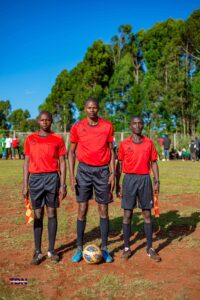
Match officials take their final pose before blowing the whistle on one of last season’s Kwanza Heroes League match. (Photo Credit: Kwanza Heroes League Media)
While many leagues focus solely on the scoreboard, Kwanza operates with a distinct “North Star”: football for social transformation. The primary goal is to drain the reservoirs of crime and drug abuse that often swallow the youth in the region. By providing a structured, competitive outlet, the league has become a vital deterrent against social vices and school dropout rates.
The impact is felt far beyond the touchline. Every match day at venues like the Ndura Sports Complex sparks a mini-economic boom. Without team buses, the local transport sector has stepped up to fill the gap. “Motorbike riders transport the teams to the venues as no team in the league is equipped with vans or buses,” Goga notes. “Local vendors get to hawk their products to the fields of play on matchdays… it has positively impacted the local economy in Kwanza.”
From the Village to the Big Stage
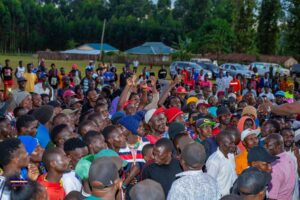
Fans storm the pitch to cheer on their teams in the Kwanza Heroes League! (Photo Credit: Kwanza Heroes League Media)
Despite its grassroots label, the quality of play is anything but amateur. The league has already begun exporting talent to the higher echelons of Kenyan football. Players like Oscar Juma (now at 3K FC in the second tier), Fauz Odhiambo, and Amon (both at Gucha Stars, second tier) serve as living proof that Kwanza is a goldmine for scouts.
What sets this league apart from the polished academies of Nairobi is a unique blend of “old school” grit and modern management. Goga points out that if a scout from a top European or North African club walked into Kwanza today, they would find a surprisingly high-tech environment. “They would find a well-organized league where all the operations are digitalized, raw local talents easy to manage, and a great passion for sports.”
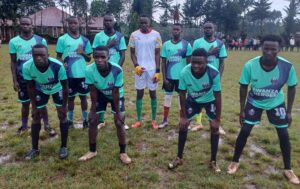
One of the teams from last season’s Kwanza Heroes League strikes a pose before kickoff. (Photo Credit: Kwanza Heroes League Media)
The League’s leadership isn’t content with remaining a neighborhood secret. The blueprint for the next half-decade is ambitious: a transition into a fully registered FKF division and a massive scale-up of infrastructure. Goga and the committee are actively calling for partnerships—ranging from corporate sponsors to local political leaders—to help develop more fields across the sub-county.
The immediate focus, however, is the highly anticipated 2026 edition, scheduled to kick off on 7th March 2026. This year’s campaign features a formidable lineup of 12 teams ready to battle for glory: Arusha Combined, Dream Star, Emoru BlackStars, Gidea FC, Hilltop FC, Karaus FC, Kipsone FC and Makhonge FC. Others are Maridadi FC, Mirembe FC, Misanga Combined and Small Simba SC.
In a world where professional football is often dominated by money, the Kwanza Heroes League reminds us that the heart of the sport still beats strongest where it is needed most.
